GUARDIAN
BAND
Across defense research in the last several years, a consistent theme is emerging: The effectiveness of future threat detection systems will depend less on centralized analysis — and more on distributed, edge-based, real-time sensing that can operate under uncertainty and communication loss. This shift is being driven by a simple operational reality: modern environments generate more signals than human operators can process, and more rapidly than traditional systems can reliably escalate.
Research on the 'Internet of Battlefield Things (IoBT)' describes this clearly — battlefield systems are evolving into dense networks of interconnected sensors, wearables, platforms, and autonomous nodes designed to support real-time situational awareness under contested conditions. The challenge is not collecting data anymore. It is deciding what matters fast enough to act on it. That distinction is where autonomy becomes essential.
The Real Bottleneck Is Not Detection — It Is Response Time
Across military AI and defense systems literature, one conclusion appears repeatedly: decision latency is becoming a primary operational constraint. As AI-enabled sensing improves, systems are increasingly capable of detecting anomalies, tracking movement patterns, and identifying potential threats in real time. But detection alone does not solve the problem.
The gap remains between:
sensing an event
interpreting its significance
and initiating a response
Traditional architectures still rely heavily on human-in-the-loop escalation — meaning a person must validate or trigger action before the system responds. In controlled environments, that may be appropriate.
In high-risk or degraded environments, it becomes a liability.
Research in AI-driven defense communications highlights that modern tactical networks are now being designed specifically to reduce this delay through AI-augmented decision systems, distributed processing, and autonomous coordination between nodes. The direction is consistent: compress the time between detection and response by moving intelligence closer to the edge.
Why Wearables Are Becoming a Critical Node in Defense AI Architecture
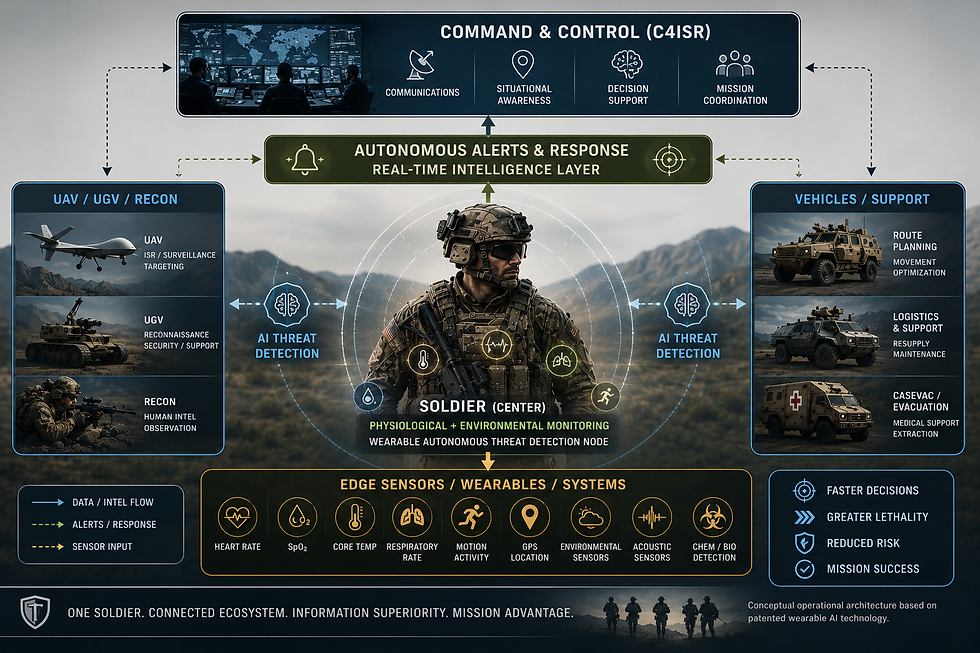
Another major shift identified in recent wearable and IoBT research is the role of the human operator as a data source within the system itself. Rather than treating personnel as endpoints, modern defense architectures increasingly treat them as mobile sensor nodes within a larger distributed intelligence network.
Recent work on tactical-grade wearable systems highlights multimodal sensing — combining physiological, motion, and environmental data to improve situational awareness and decision support in real time.
This is a significant conceptual change. It reframes the wearable not as a passive tracking device, but as an active participant in threat detection systems — continuously contributing contextual data that informs broader system behavior. However, most existing implementations still assume one critical dependency:
Human validation. And that is where the remaining gap sits.
The Weak Point in Current Systems: Human Dependency Under Stress
Even with advanced sensing, AI classification, and real-time connectivity, most systems still rely on the individual to confirm distress or initiate escalation.
This assumption breaks down in known and well-documented conditions:
incapacitation
sudden trauma
cognitive overload
communication disruption
disorientation in dynamic environments
Research into automated casualty detection and fall recognition systems has already begun addressing this issue, showing how inertial sensors and machine learning can identify incapacitation events without user input.
This is an early signal of a larger transition:
From user-triggered safety systems
to system-triggered response logic
That transition is not incremental. It is architectural.
The Emerging Direction: Autonomous Escalation at the Edge
Across cybersecurity, IoT defense systems, and battlefield AI research, a common architecture is forming:
distributed sensors at the edge
local AI inference (not cloud-dependent)
anomaly detection under uncertainty
automated escalation protocols
resilient communication pathways
Recent research in adaptive intrusion detection and edge-centric systems shows why this matters: centralized systems are too slow and too vulnerable in contested or degraded environments.
In other words, intelligence is moving outward — closer to where events actually occur.
For wearable systems, this leads to a clear implication:
If the device is closest to the event, it should not wait for external confirmation to act.
It should interpret, decide within defined thresholds, and escalate automatically.
This Is Not About Removing Humans — It Is About Removing Fragility
There is a tendency in discussions about autonomy to frame it as replacement.
That is not what the research direction supports.
Across defense AI literature, the consistent framing is augmentation under uncertainty — systems designed to maintain function when human communication or decision-making is degraded or unavailable.
Autonomy is not about eliminating human oversight.
It is about preventing system failure when oversight is not possible.
The Core Shift
The real transformation in threat detection is not better sensors or faster networks.
It is a shift in responsibility:
From systems that report conditions for human interpretation
to systems that interpret conditions for immediate action
That is the difference between monitoring and intervention.
And it is where wearable systems become strategically important — not as accessories, but as distributed decision nodes within larger defense and safety architectures.
The next generation of threat detection will not be defined by how much data can be collected.
It will be defined by how quickly systems can act when conditions deteriorate faster than humans can respond.
Across defense research, IoBT development, edge AI systems, and wearable sensor architectures, the direction is consistent:
-Detection is no longer the problem.
-The problem is latency under uncertainty.
-Autonomous threat detection exists to solve that gap — not by removing the human from the system, but by ensuring the system does not fail when the human cannot respond.
That is the real shift happening in military and high-risk environment technology today.
And it is only beginning.
Why the Next Generation of Threat Detection Must Be Autonomous
May 4, 2026